Frozen Warden Vault
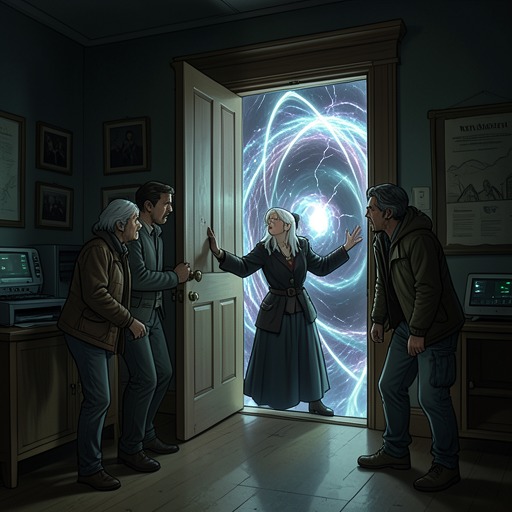
New Life as a Max Level ArchmageFrozen Warden Vault names the unexplained lockdown of the Wardens’ vault, a condition in which the guild’s adventurers are denied access to the repository that should sustain the most successful human guild in the world. Although the state is first presented as an administrative anomaly rather than a confirmed attack, its timing and proximity to Duke Caldimore’s secret preparations make it an ominous threshold: wealth has been immobilized, ordinary institutional access has failed, and the vault has become the concealed site of a dangerous ritual.
Definition and Discovery
The condition comes to light through Rafael’s investigation of Duke Caldimore’s affairs. Rafael is careful to distinguish suspicion from proof, but he identifies several irregularities that resist ordinary political explanation: the duke has taken out large loans without investments to justify them, his traveling patterns have become erratic, and the Wardens’ vault has been frozen. The restriction has already lasted thirty-six hours, and the guild’s adventurers have apparently been unable to access it throughout that period. Rafael can offer no definite explanation, which is precisely what makes the condition alarming. The freeze is not described as a routine closure, a temporary inconvenience, or a publicly explained security measure; it is a conspicuous interruption in the normal circulation of guild wealth.
The state gains additional weight because Rafael is discussing a household with extensive mercantile ties and considerable political importance. The Caldimores’ earlier dealings may have included questionable episodes and lesser political dramas, but Rafael’s closer scrutiny reveals a pattern whose most concrete sign is the vault’s inaccessibility. The frozen repository therefore operates as evidence by absence: what should be available is withheld, yet the reason for withholding it remains hidden.
Institutional and Spatial Significance
The Wardens’ guildhall presents the scale of the institution behind the vault. Its size and apparent wealth put Vanguard’s guildhall to shame, while its lobby resembles a high-class bank foyer more than a conventional adventurer headquarters. Nearly a hundred people occupy the lobby alone, with additional facilities and members-only common rooms extending beyond it. The guild is therefore not a small adventuring party’s storehouse but a corporation-sized organization whose resources, personnel, and internal spaces depend on controlled access.
That contrast clarifies the severity of the freeze. A locked vault in a modest guild would obstruct a few individuals; a locked Wardens’ vault interrupts the economic machinery of a major institution. The state places a barrier between the guild’s adventurers and the accumulated wealth they would ordinarily use, while leaving the larger organization visibly active and prosperous on the surface. The grand, open lobby and the inaccessible treasury form a pointed opposition: public scale and private paralysis coexist in the same institution.
Connection to Duke Caldimore’s Plans
The vault is not merely a financial repository. Damon Caldimore moves through it while carrying concern about the Keresi situation and enters a huge ritual chamber marked by dense magical runes. At the center lie piles of gear, materials, and miscellaneous items forming a small mound of treasure. Most of these resources are the Wardens’ wealth, taken from their members and about to be used as sacrificial catalysts. The vault’s frozen condition thus coincides with the conversion of guild property into ritual fuel.
Damon does not know whether the ritual is nearly complete or still requires days of work. The Fell Apostate, a blindfolded, gray-robed, antlered beastkin ritualist, has finished the visible spellwork as far as Damon’s limited understanding can judge, but the working is too sophisticated for him to assess confidently. This uncertainty binds the freeze to a larger concealment. The vault is sealed from ordinary adventurers at the same time that its wealth is being diverted into an arcane operation whose true progress even Damon cannot measure.
Damon’s own conduct shows why the lockdown matters politically. An unknown Titled mage, Vivisari Vexaria, has appeared near the final phase of decades of planning and has become entangled in his affairs through Saffra, whom he had treated as an expendable lesson directed at his daughter. Damon worries that an unknown Titled mage could disrupt the ritual, so he investigates rather than dismisses the coincidence. The frozen vault is consequently part of a crisis-management environment: access has been restricted, treasure has been gathered, and the ritual’s completion has become important enough that even an unlikely disturbance must be considered.
Consequences and Narrative Function
For Rafael, the Frozen Warden Vault is the most disturbing item in an otherwise incomplete chain of clues. He openly admits that he lacks concrete proof, yet the freeze is too strange to ignore, especially alongside the loans and erratic travel. He treats unexplained strangeness as a warning because it may indicate an operation concealed beneath respectable institutional activity. The vault therefore changes the practical meaning of Vivisari Vexaria’s investigation: she is no longer approaching an isolated dispute involving Saffra and Isabella Caldimore, but a household whose finances, guild authority, and ritual preparations may be converging.
The state also creates a pressure point around time. Damon has given Nysari a deadline of two days and understands that his venture will end either in success or ruin. He has avoided provoking the Keresi family too openly because the ritual’s final preparations are underway and the consequences of interference could be catastrophic for his plans. The thirty-six-hour freeze sits inside this compressed period, making the vault’s condition feel less like a settled institutional policy than a live emergency whose meaning may be decided before the deadline expires.
More broadly, the Frozen Warden Vault embodies the book’s recurring concern with systems that appear orderly while hiding coercion and danger. Account records preserve a deceased customer’s property for historical purposes; guild ranks regulate access and demand discretion; enchanted cells hold prisoners through layered magic; the Institute requires identity documents before granting library access. Against that background, the Wardens’ frozen vault is the most consequential failure of transparency. A guild can display wealth, hierarchy, and public activity while its members are silently cut off from the resources being consumed beneath them. Its significance lies not only in the locked door, but in the unanswered question of who controls what lies behind it and what that control is meant to accomplish.